Open-Source DEM Particle Simulation

GPU-accelerated DEM framework for microscale particle simulation

MUSEN is an open-source discrete-element-method (DEM) framework that resolves individual particle motion, contacts, and microscale effects. Built for multicore CPU and GPU, with industrial-scale simulations of tens of millions of discrete objects.

Open-source under BSD license. Main development and maintenance by DyssolTEC, with research roots and ongoing collaboration at TUHH.

How DEM works

An interactive look at the discrete-element method loop.

DEM tracks every grain on its own and advances the scene in tiny time steps. Press play to watch particles settle, or tick "Show details" to step through the four-stage loop — detect overlaps, compute forces, update motion, move — with the governing equations and live contact data.

Timestep: 1

Typical questions MUSEN answers

Purpose-built for microscale particle physics.

Engineering and research teams reach for MUSEN when continuum or shortcut models cannot resolve what happens at the individual-particle level: shape effects, contact mechanics, breakage, packing, and microscale segregation.

Granular flow

"How do particles flow through my hopper, silo, or chute?"

Resolve flow regimes, arching, dead zones, and discharge dynamics with explicit particle contacts and wall geometry.

Mixing & segregation

"Why does my powder mixture segregate during transport or storage?"

Track individual particle trajectories to predict mixing quality, segregation patterns, and the effect of size, density, or shape contrasts.

Breakage & comminution

"How do particles fracture inside a mill or under load?"

Bonded-particle method captures crack initiation, propagation, and fragment size distribution for milling, grinding, and structural failure studies.

Vibration & packing

"How does vibration affect packing density or segregation in my bed?"

Simulate vibrated assemblies, fluidization onset, and packing reorganization with full microscale resolution.

Non-spherical particles

"Our particles are plate-like, agglomerated, or irregular. Does shape matter?"

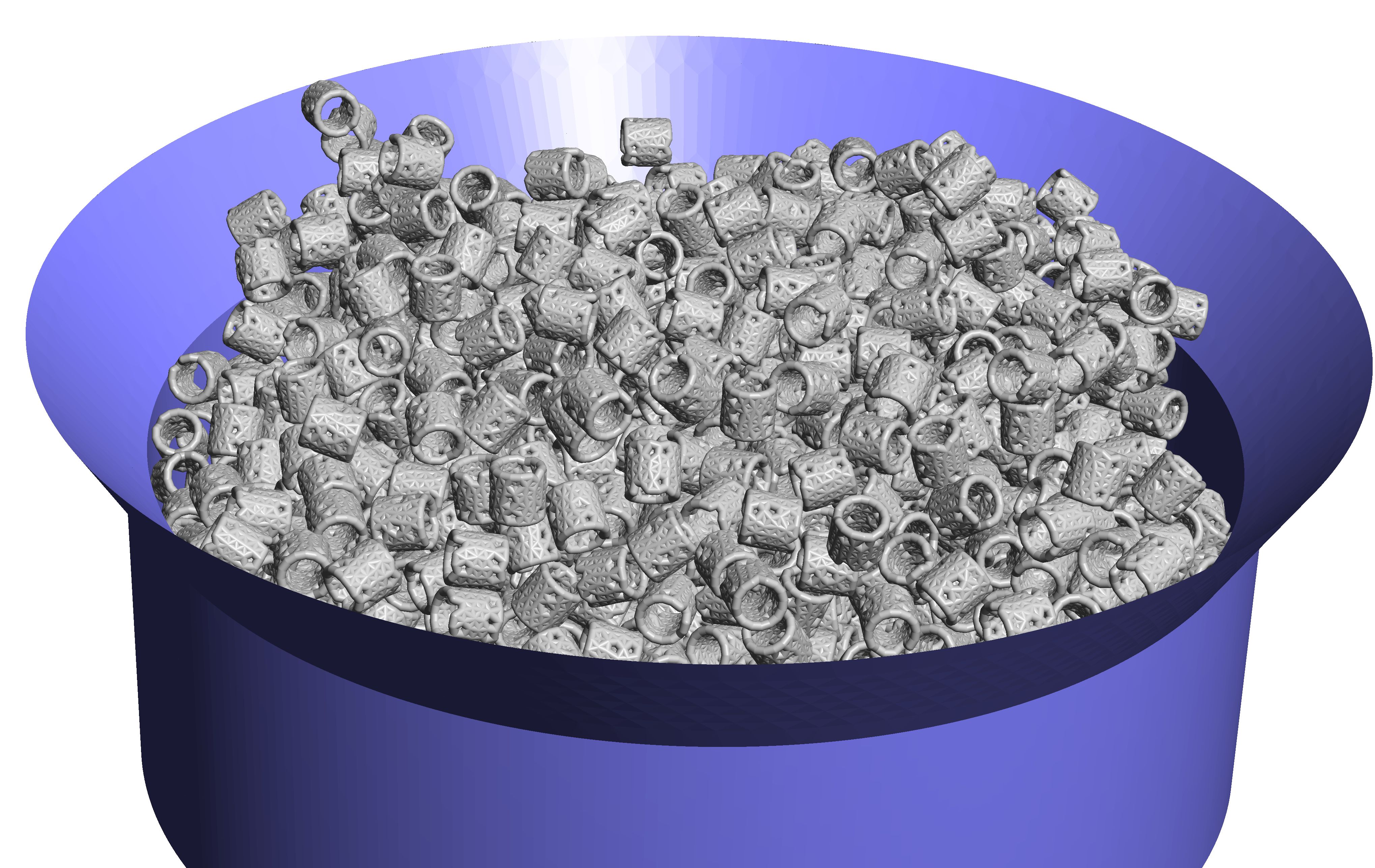
Multi-sphere and bonded clusters represent non-spherical and composite particles for shape-sensitive applications.

Custom physics

"My contact model isn't standard. Can I extend MUSEN?"

Open-source C++ codebase under BSD license. Contact models, particle generators, and analysis tools are fully customizable.

Technical capability overview

A concise reference for engineering teams evaluating technical fit.

Capability areaWhat MUSEN provides
Solver and performanceParallelized DEM solver for multicore CPU and GPU. Practical simulations on the order of 10–20 million discrete particles.
Particle representationSpheres, multi-sphere clusters, bonded agglomerates, and irregular particle shapes via composite construction.
Contact modelsHertz–Mindlin, viscoelastic, JKR cohesion, and extensible custom contact laws via the open C++ API.
Bonded-particle methodInter-particle bonds for breakage, fracture, and structural DEM studies including concrete, agglomerates, and composite materials.
Geometry importMesh-based boundary geometry (STL) for hoppers, mills, mixers, drums, and custom equipment shapes.
Outputs and analysisParticle trajectories, contact forces, packing density, kinetic and contact energy, time-series export for post-processing.
Interface and platformCross-platform GUI for Windows and Linux. C++ API for batch automation, scripting, and integration.
LicensingBSD open-source license, free for academic, research, and commercial use, including modification and redistribution.

Feature demonstrations

Representative DEM scenarios from the MUSEN library and published work.

Each example is meant to help engineering and research teams quickly assess whether MUSEN's solver and physics fit their problem.

GPU performance

Scaling DEM simulations to millions of particles on a single GPU

Engineering problem: Production-relevant DEM simulations are bottlenecked by particle count. Small assemblies miss the bulk physics, and large ones overwhelm CPU-only solvers.

Feature + demo: MUSEN's GPU implementation handles tens of millions of contacts per timestep so engineers can run physically meaningful particle counts on workstation hardware.

Granular flow

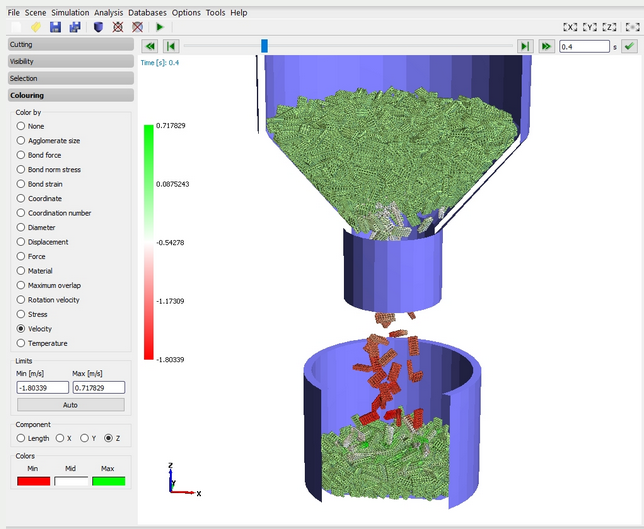
Hopper and silo discharge with realistic particle shapes

Engineering problem: Bulk-solids handling design has to predict arching, mass-flow vs. funnel-flow, and discharge rate for non-spherical materials.

Feature + demo: STL-based boundary geometry plus multi-sphere particles capture the geometry of real hoppers and the shape of real grains.

Mixing & segregation

Drum and vibrated-bed mixing dynamics

Engineering problem: Industrial mixers and vibrated beds can demix instead of mix when particle properties differ; this is invisible to bulk-averaged models.

Feature + demo: Individual particle tracking in MUSEN reveals mixing index evolution and segregation patterns directly from the simulation.

Bonded-particle method

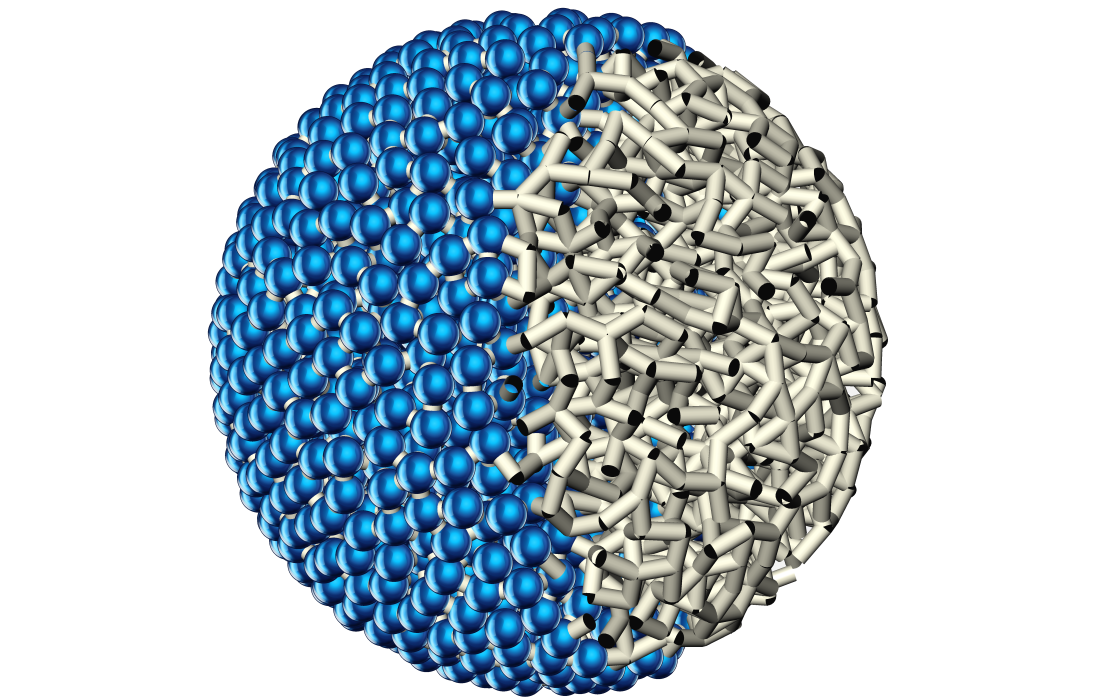
Breakage and structural DEM for materials science

Engineering problem: Predicting how composite or porous structures fail under mechanical load requires resolving inter-particle bonds, not just contacts.

Feature + demo: The bonded-particle approach in MUSEN has been validated for porous and concrete-like materials, capturing crack initiation and propagation.

Non-spherical particles

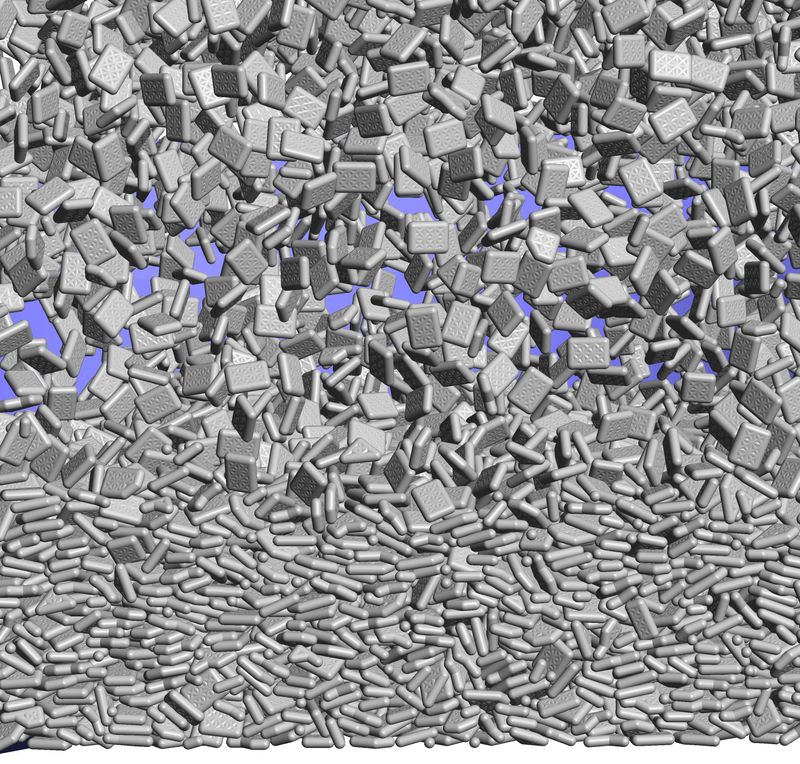
Plate-like and irregular particle assemblies

Engineering problem: Many real powders are far from spherical (clays, flakes, biomass, recycled materials), and shape changes packing, flow, and segregation.

Feature + demo: Composite shapes built from multi-sphere or bonded primitives reproduce shape-driven contact mechanics without giving up GPU performance.

Custom physics

Extending MUSEN with custom contact and material models

Engineering problem: Some industrial particles need contact laws that are not in any standard DEM toolbox, such as wet adhesion, polymer flow, sintering, or specialized cohesion.

Feature + demo: The C++ API and BSD license let teams plug in custom contact models, particle generators, and post-processing without forking off the project.

MUSEN application examples

Compact engineering examples from published MUSEN work.

Each example shows the MUSEN implementation approach and the published outcome.

MUSEN: an open-source framework for GPU-accelerated DEM

Project scope: Foundational software description of MUSEN, covering architecture, solver design, parallelization strategy, and benchmark results across CPU and GPU hardware.

How MUSEN was used: The paper presents the framework itself: GPU offload of contact detection and force computation, multicore CPU fallback, and a cross-platform GUI/CLI for scene setup and simulation control.

How MUSEN helped: Established a free, openly licensed DEM framework that scales to millions of particles on widely-available hardware, lowering the entry barrier for both research and industrial DEM users.

Practical takeaway: If your project needs large-particle-count DEM without commercial-license overhead, MUSEN provides a validated, performant baseline.

Source: Dosta & Skorych, SoftwareX 13 (2020) 100618

Mesh-free micromechanical modeling of inverse opal structures

Project scope: Predicting the mechanical response of inverse opal (a porous, periodic microstructure) under load, without resorting to finite-element meshing of the complex pore network.

How MUSEN was used: Bonded-particle DEM represented the porous solid skeleton directly; loading conditions were applied and the resulting deformation, bond breakage, and effective stiffness were extracted from the simulation.

How MUSEN helped: Mesh-free DEM avoided the geometric complexity of meshing inverse opal pores and naturally captured discrete failure events at the bond level.

Practical takeaway: For porous or hierarchical structures where meshing is painful, bonded-particle DEM in MUSEN is a viable alternative for micromechanical studies.

Source: Dosta et al., Int. J. Mech. Sci. (2021)

Three-phase DEM of ultrahigh-performance concrete (UHPC)

Project scope: Numerical study of UHPC mechanical behavior, where the concrete is represented as a coupled three-phase system (matrix, aggregates, interfacial transition zone) at the particle scale.

How MUSEN was used: A three-phase bonded-particle model was implemented in MUSEN and calibrated against measured UHPC stress-strain response, including failure modes.

How MUSEN helped: The bonded DEM approach reproduced microcrack initiation and the role of the interfacial transition zone in UHPC failure, providing a microscale view that bulk continuum models cannot.

Practical takeaway: For composite or multi-phase materials with critical interfacial behavior, three-phase bonded DEM in MUSEN is a useful complement to continuum models.

Source: Rybczynski et al., Structural Concrete (2020)

Micromechanical analysis of roller compaction with DEM

Project scope: Particle-scale study of the dry-granulation roller compaction process, covering particle flow into the nip, porosity distribution in the compaction zone and final ribbon, and pressure distribution on the rollers.

How MUSEN was used: An elasto-plastic contact model was calibrated against material data and applied to a roller-compactor geometry in MUSEN. The simulation resolved particle rearrangement, densification, and stress development as material passes through the rolls.

How MUSEN helped: By tracking particle-level behavior through the compaction zone, the study exposed local porosity and pressure distributions that bulk or continuum models cannot resolve, supporting a clearer understanding of how operating settings shape ribbon properties.

Practical takeaway: For dry-granulation studies where ribbon quality depends on local densification and stress fields, DEM with a calibrated elasto-plastic contact model gives process-level insight that continuum approaches miss.

Source: Eichler et al., Powder Technology 398 (2022) 117146

Technical questions about MUSEN?

Speak directly with the DyssolTEC team, main developers of MUSEN, about DEM modeling for your process.

Contact us